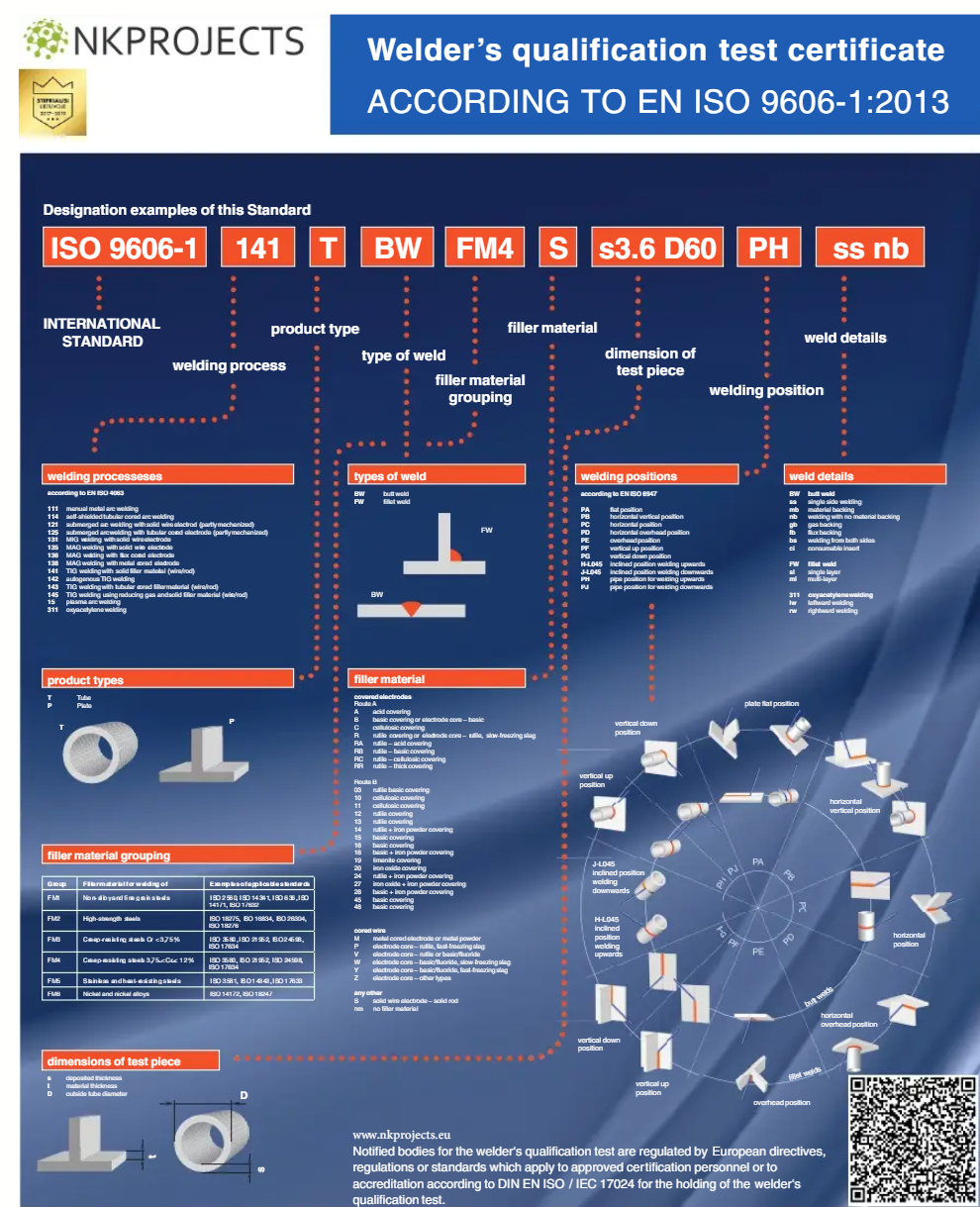
Quick answer: in 2026, the hourly rate for a UNE-EN ISO 9606 qualified welder in Spain runs between 17 and 35 €/h depending on process, material and position; piping profiles in 6G/H-L045 go above 35 €/h. But the rate is not the cost: once you add per diems, lodging, travel, PPE, insurance and management, the real cost to the company lands around 1.6-2x that figure. Let us break it down.
Rates by specialty and position
Nearly everything published online answers "what does a welder earn" — the worker's salary according to salary portals and the provincial metal-sector collective agreement tables. What matters here is the other end: what the buying company pays per welded hour. Indicative market bands for 2026:
- MIG/MAG (135/136) on plate and structure: 17-22 €/h — the entry step, with the largest supply of professionals.
- Stick (111) on maintenance and structure: 18-24 €/h.
- MIG/MAG or stick on piping: 20-28 €/h — pipe always pays above plate, because of the root pass and the radiograph.
- TIG (141) on stainless plate: 22-28 €/h.
- TIG on carbon piping: 24-30 €/h.
- TIG on stainless and alloy piping: 28-35 €/h.
- Piping in 6G/H-L045, high pressure, duplex or nickel: above 35 €/h, with clearly higher peaks during urgent shutdowns.
The reading rule: every jump in difficulty — plate to pipe, carbon to stainless, comfortable position to 6G — shrinks the pool of available welders and pushes the rate up.
Hour, day, joint or package: how it gets invoiced
On shutdowns and short peaks the norm is billing per worked day, with 10 effective hours and a calendar closed in advance. On continuous work, billing is per certified hour. On erections with a measurable scope, the market shifts to price per joint or per diameter inch, and on large projects to a closed package with productivity clauses (minimum joints per day) and quality clauses (maximum repair percentage at the supplier's expense). Each model distributes risk differently: the hour shifts productivity risk to the client; the package hands it back to the supplier. That is why the "cheap" package is only cheap if the scope is genuinely defined — and why a serious supplier asks uncomfortable questions before quoting.
The hidden total cost: why 1.6-2x the rate
The hourly rate is only the visible line of the budget. A real mobilization in Spain adds:
- Per diems and meals — on displaced work, a fixed daily cost per worker.
- Lodging — weeks or months near the plant; in shutdown hotspots (Cartagena, Tarragona, Huelva) prices spike when several firms mobilize at once.
- Travel — round trips, mileage or flights, and travel hours somebody pays for.
- Specific PPE — flame-retardant clothing, helmet, technical gloves; consumables that get replaced.
- Occupational medical checks — a valid fitness certificate and, depending on the plant, specifics (heights, confined spaces).
- Health and safety training — the prevention hours the metal sector requires and, where applicable, the preventive resource present on high-risk tasks.
- Insurance and employer costs — liability cover, collective-agreement insurance, social contributions.
- Non-productive hours — plant entry accreditations, safety induction, site tests.
Run the numbers and a nominal 25 €/h rate easily becomes 40-50 €/h of effective cost per welded hour. Budgets that ignore this layer blow up mid-project.
A round-number example: a 3-week shutdown with 4 TIG pipe welders at 28 €/h and 10-hour days. The visible invoice sits around 23,500 €. Add per diems and lodging for four displaced workers (easily 6,000-8,000 € in a shutdown zone, when half the province mobilizes at once), transport, PPE, medical checks and the entry-accreditation hours, and the real cost settles around 38,000-45,000 € — the famous 1.6-2x. The good news: it is a predictable cost if budgeted in full from the start, and a negotiable one if lodging or transport is provided by the client or arrives already solved by the supplier.
Labor supply, subcontracting or direct hiring (and the freelancer)
The right formula depends above all on the duration and shape of the workload:
- Short peak (days to 6-8 weeks, shutdowns): external supply of qualified personnel. You pay a premium on the hour, but you buy speed, verified documentation and zero employment liability afterwards.
- Project of 2 to 9 months: subcontracting a closed package (joints, tonnage) or supply with a stable crew — the hourly cost drops with the duration commitment.
- Stable load beyond 12 months: direct hiring wins on cost per hour, but you take on recruiting in a scarce market, retention and the whole employer cycle.
- Freelancer: the hour looks cheaper on paper, but the buyer absorbs document verification, false self-employment risk, insurance coverage and the absence of a substitute if the professional drops out mid-shutdown.
Whatever the formula, three things are worth demanding by contract from any supplier: the complete documentation dossier for every welder before mobilization (qualifications, medical fitness, safety training), liability insurance with coverage matching the plant's risk, and a substitution commitment with a deadline — if a welder drops out, how many hours until the next one arrives with the same qualification. Those three clauses cost nothing in the negotiation and are worth an entire shutdown when something goes wrong.
What raises the price — and what lowers it
Raises it: urgency (mobilizing in 48-72 h carries a premium), stainless, duplex and nickel alloys, difficult positions and single-side welding without backing, night and weekend shifts, and extra plant requirements (ATEX, confined spaces, inert-gas purging).
Lowers it: committed volume and duration, planning weeks ahead, a well-defined scope (joint count, WPS ready, materials on site) and continuity — repeating the same crew between shutdowns removes accreditation hours and the adaptation curve.
The urgency premium deserves its own number: a 48-72 h mobilization usually runs 10-25% above the planned rate, because it means pulling professionals off another assignment or bringing travel forward. Even so, it tends to beat the cost of a day of stopped plant. At the other end, the "noble" materials get expensive twice over: the specialist's hour costs more and the joints-per-day pace is slower — stainless, duplex and nickel alloys do not forgive haste.
The cost of the "cheap" rate: rework
There is one cost no rate table captures: the rejected joint. A welder 30% cheaper, with no valid qualification or one outside its range, stops being cheap at the first radiograph: the joint is cut out, re-prepared and re-welded, with inspection repeated and the crane, scaffolding and the rest of the crew waiting. On a shutdown, a single failed batch can consume more margin than everything "saved" on the rate. That is why an honest comparison between offers starts with verifying the qualification of every welder proposed — zero defect is not a sales slogan, it is the variable that decides in hindsight whether the rate was expensive or cheap.
Frequently asked questions
What does a 6G welder cost per day on a shutdown?
With 10 effective hours per day, a realistic 2026 band sits between 380 and 550 € invoiced per day, plus per diems and lodging when not included. Urgency and the alloy being welded push toward the top of the band.
Why does it cost me 1.8x what the welder "earns"?
Because between salary and invoice live the social contributions, insurance, per diems, lodging, PPE, safety training, document management and non-productive hours. It is the gap between salary and employer cost — it exists under every formula, direct hiring included.
Is it not cheaper to hire directly?
Only with a long, stable workload. On peaks and shutdowns, the cost of recruiting in a scarce market, the lead time until a qualified person is actually welding and the employment liability afterwards eat up the rate difference — the full math is in how to hire a certified welder in Spain.
Want numbers for a concrete case? Spell out process, material, thickness, position, joint count and dates, then meet our UNE-EN ISO 9606 qualified welders or request a closed quote — the sharper the scope, the tighter the price.