Short answer: UNE-EN ISO 9606 is the European standard that qualifies the person doing the welding — one document per welder, with a defined process, material, thickness and position. AWS D1.1 (Structural Welding Code: Steel) is a different animal: a complete North American structural code that governs everything from joint design to acceptance criteria, and includes welder qualification as one of its chapters. On a project in Spain, the default is ISO 9606; AWS only enters when the contract or the licensor imposes it.
Point-by-point comparison
- Nature: ISO 9606 is a welder qualification standard; D1.1 is an integral structural welding code (design, procedure, qualification, inspection and acceptance).
- Region and legal framework: ISO 9606 is the reference in the EU and slots into the European ecosystem — EN 1090 on structures, EN ISO 15614 for the procedure (WPQR), EN ISO 3834 for quality management. D1.1 dominates the US, Canada and American-led projects worldwide.
- Validity: the most treacherous difference. Under D1.1, welder qualification remains valid indefinitely as long as no more than 6 months pass without using the process (and there is no reason to question the welder's skill). Under ISO 9606 there is a mandatory six-month confirmation plus revalidation every 2-3 years depending on the chosen route. An "old" AWS certificate may be alive; an ISO 9606 without confirmations is dead.
- Materials and scope: D1.1 covers carbon and low-alloy structural steel (stainless has D1.6; aluminium, D1.2). ISO 9606-1 covers steels in general by groups, and Parts 2 to 5 extend to aluminium, copper, nickel and titanium.
- Who demands it: ISO 9606 — European clients and CE marking; D1.1 — American EPCs and licensors, US-spec offshore work and fabrication bound for the United States.
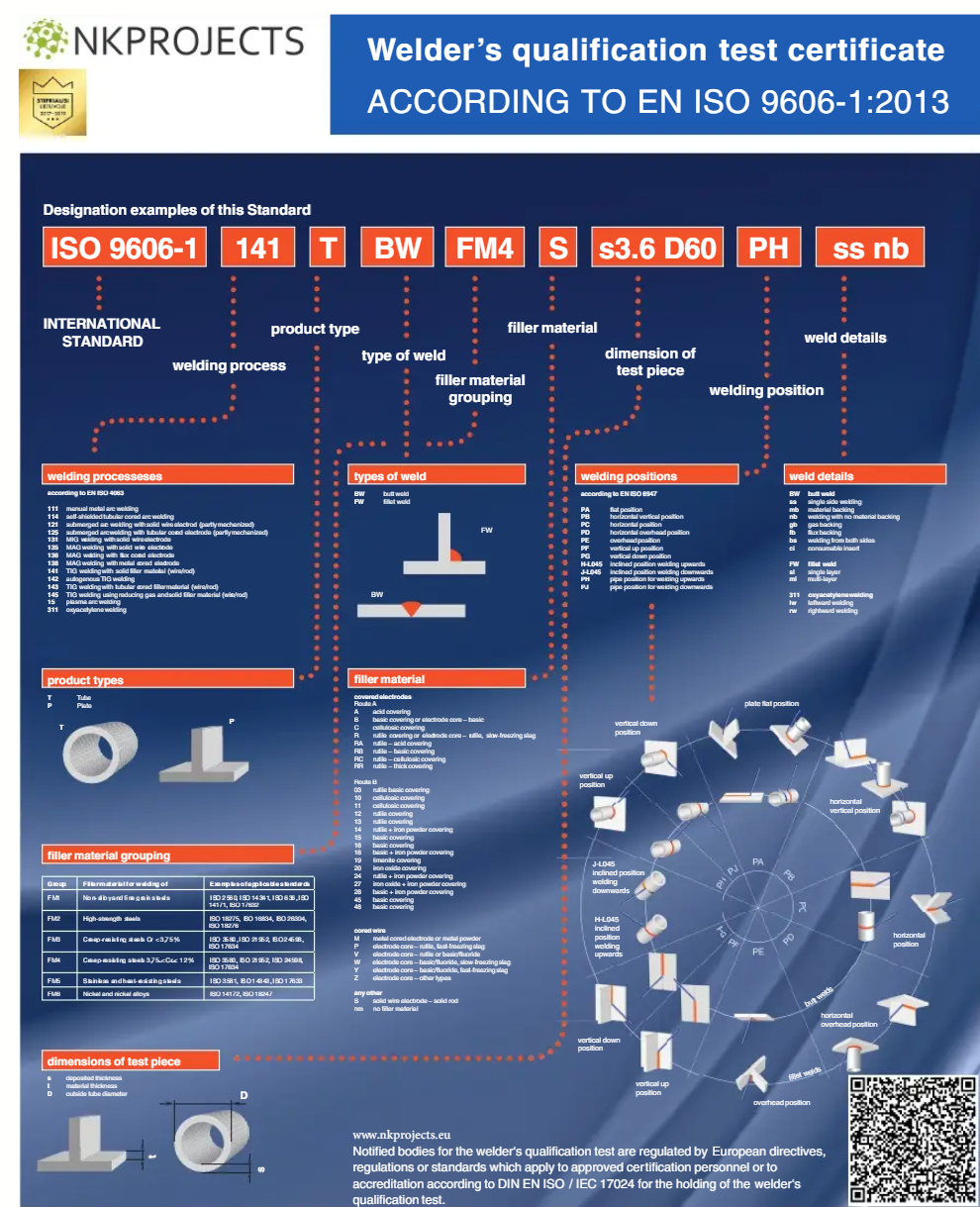
- Coupons and paperwork: D1.1 works with 1G-6G positions and its own AWS record formats; ISO 9606 uses the PA-PJ/H-L045 nomenclature and field-by-field coded designations. The documents do not even look alike — one more reason informal "translations" end in a dispute with the inspector.
- Exam logistics: qualifying under ISO 9606 in Spain is routine, with bodies and examiners across the territory; setting up an AWS session with a recognized examiner takes more lead time. That lead time, more than the coupon's price, is what usually hurts on site.
The operational takeaway from the comparison: it is not that one standard is "better", it is that they answer to different hierarchies. In Europe, the qualification of the person (ISO 9606) is one piece inside a system of EN ISO standards that reference each other; in the AWS world, the product code drags its own qualification along with it. Choosing wrong is not an administrative nuance: it is showing up to inspection with papers the inspector does not recognize.
When a project in Spain requires AWS D1.1
Four scenarios routinely bring AWS into a Spanish contract:
- American EPC or licensor — the engineering firm that owns the process imposes its full normative package, and welder qualification comes inside it.
- Offshore and oil & gas on US specifications — projects governed by API specifications and AWS/ASME codes, even when executed in European yards.
- Fabrication for export to the US — structures or equipment that will be inspected at destination under the American code.
- Naval and defense programs with US roots — hubs like Cartagena combine shipyard, refining and energy, and it is not unusual for contracts under both frameworks to cross paths in the same city.
Outside these cases, demanding AWS on a Spanish site only adds cost: you pay for a qualification the local inspector will never ask for.
A typical case illustrates it well: fabrication in a Spanish workshop of structures for a plant an American EPC will erect across the Atlantic. The workshop works daily under EN 1090 with ISO 9606 welders, but the contract refers to AWS D1.1 — and the client's final inspection will apply the American code's acceptance criteria, not the European ones. Catching that during specification review, before signing, allows qualifying the welders under D1.1 with time to spare and without the urgency surcharge.
Do they cross-validate? No — and there is no shortcut
There is no automatic equivalence in either direction. Coupons, positions, reference materials and acceptance criteria differ, and no body "translates" one certificate into the other. The practical path when a contract demands both is to use a single exam session: weld coupons under both schemes, with an examiner or body qualified for both, and walk out with both certificates at once. For crews rotating between European and American projects, keeping a qualification matrix per welder (which standard, which process, which validity) prevents mobilization surprises.
In time and money, planned dual qualification is manageable: the extra coupons and examiner fees cost a fraction of what halting a site while waiting for certificates costs. The key word is "planned": arranging a dual session with the right body takes weeks, not days — exactly the kind of lead time that evaporates when the specification is read late.
The buyer's checklist
- Read the specification before qualifying — the code governing the project decides everything; qualifying first and asking later means paying twice.
- If the contract says D1.1, demand the D1.1 package — WPS and PQR to AWS, not just the welder's certificate.
- Check continuity — under AWS, activity in the process with no gap over 6 months; under ISO 9606, six-month confirmations and revalidation up to date, as explained in our guide to UNE-EN ISO 9606 qualification.
- Never accept "generic equivalences" — if you need both, demand both certificates, each with its own verifiable number.
- For dual profiles, ask for the matrix — welder by welder, standard by standard, with dates.
Frequently asked questions
Does an AWS certificate work on a CE-marked (EN 1090) job?
Not as a substitute. EN 1090 refers to qualification under the EN ISO standards; D1.1 can be added as an extra client requirement, but it does not replace ISO 9606 before the European framework.
Which of the two is "harder"?
Neither is universally tougher: coupons, positions and acceptance criteria change. The real difficulty is set by the joint — a 6G/H-L045 stainless pipe weld is demanding under either scheme.
What do I ask for if I do not yet know the project code?
By default, in Spain, ISO 9606 — that is what the local inspector will request. If an American licensor is a possibility, plan dual qualification from the start: it costs far less than repeating exams mid-project.
What about ASME IX? Is that not the same as AWS D1.1?
No. ASME IX is the qualifications section of the American boiler and pressure vessel code: the reference for process piping and pressure equipment on American-spec projects. D1.1 is structural. If your project is a process unit under American specification, it will most likely call for ASME IX rather than D1.1 — but the logic of this article holds unchanged: identify the code governing the contract, qualify under it, and accept no informal equivalences.
Iron Pulse mobilizes welders qualified to ISO 9606 and, when the project demands it, with AWS qualification in parallel — always with a verified documentation dossier, as described on our quality page. Meet our qualified welders.